
SWIPEBY.
Ordering made connected.
Built for restaurants.
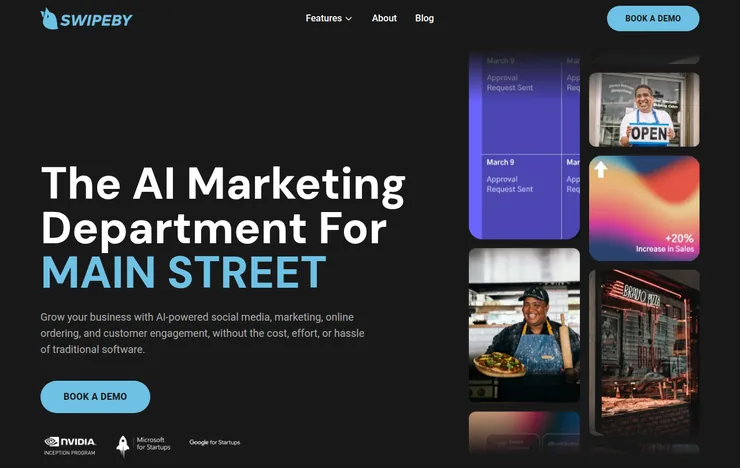
Anviam developed SWIPEBY from scratch with .NET, Angular, microservices and Azure, bringing AI capability into a food-ordering and delivery application for the US market.
From menu discovery
to connected ordering.
- .NET backend
- Angular frontend
- Microservices
- Azure & AI
Conceptual workflow illustration · Not a product screenshot
From Menu Choice to Restaurant Fulfilment
- The productA food-ordering and delivery application for the US market.
- Anviam's contribution.NET, Angular, microservices, Azure and AI capability, built from scratch.
- The purposeConnect customer selections with restaurant-ordering workflows.
AI-Enabled Restaurant Ordering Built on a Connected Platform
Anviam developed SWIPEBY from scratch using .NET, Angular, a microservices architecture and Azure: an AI food-ordering and delivery application for the US market.
Product Context
Public sources describe restaurant ordering and a consumer curbside app. The current website also presents a broader AI marketing platform; not every current module is attributed to Anviam's engagement.
Users and Responsibilities
Customers browse and order food; restaurants maintain menus and fulfil orders through the management workflow. A standalone driver app or delivery fleet was not confirmed.
Connecting Customer Choices With Restaurant Fulfilment
Engineering requirements relevant to the delivery scope, not a history of verified incidents.
Menu and Availability Consistency
A customer's selection stays consistent with available items, modifiers and pricing. An accepted cart should never hide an unavailable menu configuration.
Clear Fulfilment Choices
Pickup, curbside and delivery need different information and expectations, so the interface communicates the selected service and its availability.
Reliable Order State
Payment, restaurant acceptance and fulfilment are distinct events. Retries and interruptions are handled without duplicating an order.
AI Within Operational Boundaries
AI assistance uses permitted, current context within defined responsibilities. No autonomous ordering is assumed.
.NET, Angular, Microservices and Azure, Built From Scratch
The application was developed from scratch using the architecture and stack supplied for this case study.
.NET Backend
Backend application work, validation and order-state handling in .NET.
Angular Frontend
Menu selection, order context and clear transaction states built with Angular.
Microservices Architecture
Service responsibilities and integration contracts around the product's domains.
Azure and AI
Cloud deployment on Azure, with AI capability built into the ordering product.
Restaurant Discovery, Direct Ordering and Repeat Purchase
Public product context, kept separate from Anviam's development scope.
Discover
- Browse local restaurants and menus
- Food filters, favourites and saved preferences
- Restaurant-branded online storefronts
Order
- Menu item customisation
- Cart and in-app payment
- POS connections and order management
Fulfil and Return
- Pickup, curbside and delivery options
- Order history and reordering
- Loyalty and AI capability
Discover the Menu. Place the Order. Choose How It Arrives.
Based on the public consumer listing and ordering page. No payment or real order was submitted.
Discover a restaurant
Browse participating restaurants or enter a branded storefront.
Explore the menu
Review available items and discovery filters.
Customise the selection
Choose available item options and quantities.
Select fulfilment
Choose pickup, curbside or delivery where supported.
Review the basket
Check items, configuration and order details.
Pay and submit
Complete the configured purchase flow.
Restaurant receives it
The order-management and POS workflow supports restaurant handling.
Collect or receive
Follow the fulfilment process, including curbside collection.
Revisit and reorder
Use history, favourites or loyalty for later orders.
Microservices Behind an Understandable Ordering Experience
Engineering considerations for the confirmed stack, rather than an inspected service diagram.
Microservice contracts
Define responsibility for menus, order state and other product domains according to the actual implementation.
Order consistency and retries
Explicit identifiers and recoverable transitions for submissions and provider callbacks. Payment acceptance and restaurant fulfilment are never treated as the same event.
Menu and POS boundaries
Agree sources of truth and update behaviour where connected menus are used.
Angular interaction states
Make unavailable items, required choices, processing and failure states clear throughout the ordering journey.
Azure operations
Define access, deployment, monitoring and recovery responsibilities. Azure hosting alone does not establish an availability guarantee.
AI task definition
Define the AI capability, permitted context and evaluation criteria for each use.
A Full-Stack Foundation for Restaurant Ordering
The delivery combines .NET, Angular, microservices, Azure and AI capability in an application developed from scratch.
Useful measures include valid cart completion, failed or duplicate orders, menu consistency, payment reconciliation and fulfilment status latency. No revenue, conversion or delivery-speed figure is claimed.
Connected Ordering Capability
Customer-facing software connected with the backend and cloud architecture behind restaurant ordering.
Customer Privacy, Payment Scope and Ordering Transparency
Obligations depend on market, data processing and provider contracts. No independent compliance audit or certification is claimed.
Customer, Address and Location Data
Data purposes, permissions, notices and retention, with no more location precision than the order needs.
Payment Responsibilities
Card-data handling and PCI DSS scope established from the actual payment flow. No PCI validation is claimed.
Messaging and Marketing Preferences
Promotional email, SMS, tracking and loyalty processing reviewed under applicable rules.
Restaurant and Admin Access
Appropriate visibility for restaurant staff and administrators.
Food and Fulfilment Information
Accurate item options and order terms. No automated allergen checking or guaranteed delivery outcome is claimed.
Store Disclosures and AI Boundaries
App-store and website statements are publisher-provided; actual processing and AI-provider terms are reviewed before blanket claims.
Why Anviam for Your Food-Ordering and Delivery Platform?
Bring customer experience, backend services and cloud architecture together around the restaurant-order lifecycle. See our mobile app development and cloud & DevOps services.
Talk Through Your Project- Development from scratch: a product built from the ground up, not a reskinned template.
- .NET application experience for validation and order-state handling.
- Angular frontend delivery for menu, customisation and order interactions.
- Microservices architecture with clear service responsibilities.
- Azure cloud experience connecting development with operations.
- Restaurant workflow context: customer choices, restaurant handling and fulfilment.
- Branded ordering opportunities for custom and white-label experiences.
- Evidence-led acceptance criteria across the order lifecycle.
Sources and evidence
Development scope supplied by Anviam. Website and Android listing reviewed; current marketing modules may reflect later product expansion. No installed app, order, source code or security controls were inspected.