
MyMediScribe.
Clinical notes meet AI.
Built for review.
Anviam developed MyMediScribe from scratch using Python/FastAPI, connecting LLMs, RAG, AI models and OpenAI within a healthcare documentation application.
From consultation input
to reviewable notes.
- Built from scratch
- Python / FastAPI
- OpenAI & AI models
- LLM & RAG
Conceptual workflow illustration · Not a product screenshot
From Clinical Source Material to Reviewable Documentation
- The productAn AI-assisted medical documentation application.
- Anviam's contributionPython/FastAPI, OpenAI, LLMs, AI models and RAG, built from scratch.
- The purposeConnect clinical input with structured drafts and clinician review.
Clinical Documentation Powered by Connected AI Workflows
Anviam developed MyMediScribe from scratch using Python/FastAPI with LLMs, RAG, AI-model and OpenAI integration, for healthcare documentation and clinician-led workflows.
Product Context
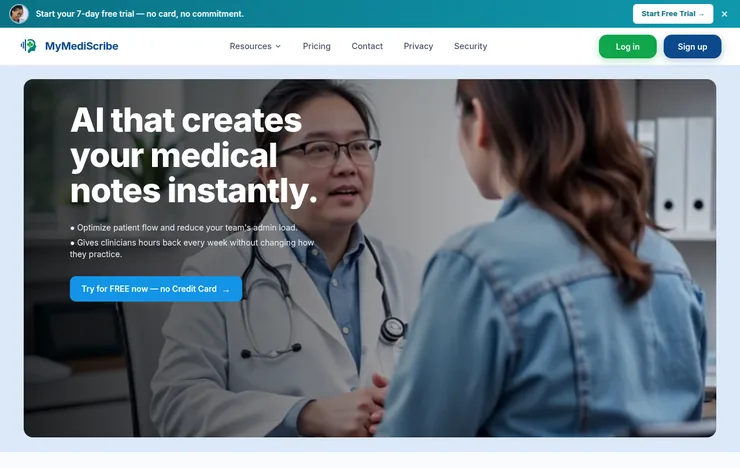
The public website presents an AI medical scribe. Its current capabilities give feature context; not every present-day module is attributed to the original engagement.
Users and Responsibilities
Clinicians need reviewable documentation with clear source meaning, and practice teams need appropriate data boundaries. AI text stays distinguishable from approved records.
Useful Clinical Drafts Need Grounding, Review and Context
Engineering requirements relevant to the delivery scope, not a reconstructed incident history.
Preserve Clinical Meaning
Generated notes can omit a relevant detail or introduce an unsupported statement. Evaluation considers completeness and meaning, not fluent wording alone.
Keep Patient Context Separate
Capture, retrieval and generation need the intended patient and encounter context. A useful reference must never expose another patient's information.
Make Review Practical
Source material, generated text and edits stay clearly distinct. A completed generation is not a clinician approval.
Handle Processing Exceptions
Capture interruptions, incomplete input and model or provider failures need understandable recovery.
Python, FastAPI and AI Integration, Built From Scratch
The platform was developed from scratch using the stack and scope supplied for this case study.
Development From Scratch
The healthcare AI product, developed from the ground up.
Python / FastAPI
Application development and API services in Python and FastAPI.
LLM and OpenAI Integration
Language models, AI models and OpenAI integrated into the documentation workflow.
RAG Implementation
Retrieval-augmented generation, with retrieval treated as context rather than proof of correctness.
From Consultation Input to Structured Clinical Drafts
Features advertised on the public website. Current implementation and engagement attribution were not independently tested.
Capture
- Voice recognition and ambient capture
- Visit recording upload
- Written transcript
Document
- SOAP, APSO and SOAPIE note formats
- Specialty templates and template builder
- AI editing and visit preparation
- Generated patient instructions
Connect
- EHR handoff (advertised; individual EHRs not confirmed in scope)
- Differential suggestions (not clinically validated)
- LLM and RAG foundation (Anviam scope)
Capture the Encounter. Draft the Note. Review Before Use.
A product-level documentation journey based on public features. No authenticated screens or patient data were accessed.
Prepare the encounter
Establish the intended patient and visit context.
Capture or upload
Use voice capture or provide a visit recording.
Transcribe the source
Prepare the written consultation material.
Select the note format
Choose from the available specialty and template options.
Generate a draft
Produce a structured SOAP, APSO or SOAPIE note.
Review and edit
The clinician checks meaning, omissions and unsupported content.
Review related outputs
Check patient instructions and other generated content before use.
Approve and hand off
Use the authorised record workflow after clinician review.
Preserve records
Apply the retention and access policy to sources and documentation.
LLM and RAG Integration Within a Healthcare Application
Relevant engineering considerations, not an inspected implementation or clinical validation result.
FastAPI request and job states
Define validation, failure states and result ownership, distinguishing accepted input, ongoing processing and a completed response.
RAG permissions and provenance
Retrieve only appropriate context and preserve source identity. Patient information and reference material need deliberate access boundaries.
Model input and output structure
Define the generation task, note format and handling of missing information.
Clinical-content evaluation
Evaluate unsupported additions, omissions and changes in meaning against representative sources. No accuracy score is claimed.
OpenAI and third-party processing
Establish provider settings, retention, terms and permitted data before processing sensitive content. OpenAI integration alone does not establish a healthcare compliance arrangement.
Review and handoff boundaries
Keep draft, edited and approved states distinct. A successful model response does not mean an external patient record was updated.
A Full-Stack AI Foundation for Clinical Documentation
The engagement combines development from scratch, Python/FastAPI and LLM/RAG/OpenAI integration.
Useful measures include time to a reviewable draft, clinician editing effort, omissions and unsupported statements. No time savings, diagnostic accuracy or adoption figure is claimed.
Connected Application Capability
AI processing and retrieval connected with a healthcare product built for documentation workflows.
Patient-Data Protection and Clinician Accountability
Requirements depend on jurisdiction, deployment and actual data processing. No independent compliance audit or clinical certification is claimed.
HIPAA Applicability and Agreements
Where PHI and covered entities or business associates are involved, assess safeguards and BAAs. An AI provider integration alone does not establish HIPAA compliance.
GDPR / UK GDPR Where Applicable
Lawful processing, health-data conditions, transparency, minimisation, retention, processors and transfers, plus a DPIA where required.
Published Security Claims
The security page advertises encryption, access controls and HIPAA-aligned workflows; these are publisher claims, not independently audited.
Infrastructure vs Application Assurance
The site attributes certifications to AWS infrastructure and says its application controls have not been independently audited.
Clinical Review and Diagnostic Boundaries
Generated notes and suggestions need professional review before clinical use. No medical-device status is claimed.
Patient Context and Source Lifecycle
Recording permissions, encounter association, restricted access and retention or deletion rules.
Why Anviam for Your AI Medical-Scribe Project?
Bring healthcare application development together with language-model and retrieval integration. See our AI medical scribe development and generative AI services.
Talk Through Your Project- Developed from scratch: a healthcare AI product built from the ground up.
- Python application experience for processing responsibilities and behaviour.
- FastAPI integration with validation, response states and recoverable handling.
- LLM and AI-model work with acceptance criteria around reviewable output.
- OpenAI integration with explicit boundaries for sensitive content.
- RAG implementation with permitted source context and provenance.
- Clinical-documentation context: source meaning, structured drafts and review.
- Evidence-led success measures for content quality, usability and speed.
Sources and evidence
Development scope supplied by Anviam. Public features may reflect later releases. No patient data, authenticated application, source code, model evaluation or security audit was accessed.