
HealthOrbit AI.
Clinical workflows.
Connected by AI.
Anviam developed HealthOrbit AI's web application and Flutter mobile app, implemented AI workflows and connected healthcare systems, with LLMs, RAG, prompt engineering, voice APIs and EHR integration.
From consultation
to a reviewed draft.
- Web application
- Flutter iOS & Android
- LLM/RAG & prompts
- EHR & voice APIs
Conceptual workflow illustration · Not a product screenshot
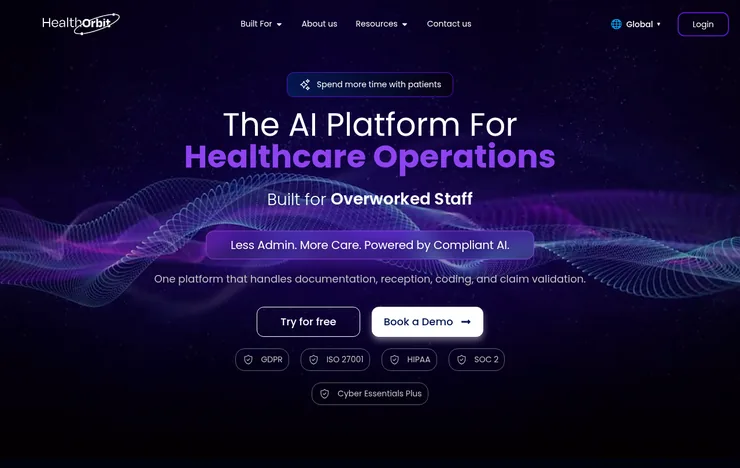
From Clinical Conversation to a Reviewable Draft
- The productAn AI-assisted documentation and healthcare workflow platform.
- Anviam's contributionWeb app, Flutter mobile, AI implementation and EHR integration.
- The purposeConnect clinical input, AI-assisted drafting and clinician-led record workflows.
Clinical Assistance Across Web, Mobile and Existing Systems
HealthOrbit AI supports healthcare documentation and related workflows. Its public app listings describe transcription, clinical summaries and reviewable drafts for doctors, clinicians and clinic teams.
Project Overview
Anviam's role covered web application development, Flutter mobile development, AI implementation and EHR integration, including LLMs, RAG, prompt engineering, model-provider and voice APIs, and work on hallucination reduction and AI-scribe speed.
Users and Decision-Makers
Clinicians need a draft they can verify, edit and use. Practice teams need connected systems, while technical and governance stakeholders need clear data boundaries. Patients are affected participants, not substitutes for clinical review.
Clinical Documentation Needs More Than Fluent Text
Requirements that follow from the product purpose and engineering priorities, not a reconstructed history of customer incidents.
Clinically Grounded AI Drafts
A polished summary can still contain an unsupported detail or omit important context. The product preserves what was provided, flags uncertainty and makes review practical.
AI That Fits the Consultation
Recording, processing and drafting need understandable states: uploading, transcribing, generating or ready for review. Reducing waiting time is an engineering objective.
Connecting the Right Patient Record
Clinical information must reach the intended patient, encounter and organisation, with clear feedback for pending or failed transfers.
Resilient Mobile and Voice Workflows
Mobile permissions, network interruptions and voice-service failures can interrupt a workflow. Recovery preserves context and avoids duplicated actions.
Applications, AI and Healthcare Integration
The confirmed scope spans the user-facing applications and the AI and healthcare-system connections behind them.
Web Application
A coherent interface for clinical input, generated content and workflow actions, with clear boundaries between a draft and a reviewed record.
Flutter Mobile App
iOS and Android apps built with Flutter, handling recording permissions, connectivity changes and review on smaller screens.
AI and Prompt Engineering
LLM and RAG work with OpenAI and Google Vertex AI, plus prompt engineering focused on reducing hallucination and improving AI-scribe speed.
EHR and API Integration
Connections with EMIS, SystmOne, Cadence, Klinik and Lifeline, plus Twilio, Vapi, text-to-speech and voice AI services.
AI Assistance Within a Clinician-Led Workflow
Public product descriptions give feature context; marketing claims are not presented as measured project results.
Consultation Input and Transcription
Audio or note input with AI-assisted transcription, designed around clear recording state, source association and recovery when an upload or processing step fails.
Structured, Editable Clinical Drafts
Clinical summaries and templates with clinician review before use. It supports documentation; it does not replace professional judgement.
LLM, RAG and Prompt Workflows
RAG adds permitted reference context to generation, but retrieval alone does not make output correct. Source relevance and unsupported statements need evaluation.
EHR, Telephony and Voice Connections
A successful voice exchange, AI draft and EHR transfer stay separately observable states across Twilio, Vapi, text-to-speech, OpenAI and Vertex AI.
Record the Consultation. Create SOAP Notes. Review and Connect.
Based on HealthOrbit's public ambient AI scribe description. Screen order and integration behaviour depend on the deployment.
Record the consultation
Capture the clinical conversation through ambient recording on web or mobile.
Transcribe
Convert spoken consultation content into text for the documentation workflow.
Process with AI scribe
Prepare a structured clinical draft in the chosen format.
Generate SOAP notes
Organise the draft into Subjective, Objective, Assessment and Plan, or another template.
Prepare related documents
Draft referral letters, discharge summaries or handover notes where needed.
Review and edit
The clinician checks meaning, corrects omissions and removes unsupported content.
Approve the final note
Approval separates the generated draft from documentation ready for the record.
Connect to EHR / EPR
Send approved documentation through an authorised, configured integration.
Confirm the handoff
Check transfer status and resolve failures before treating the update as complete.
What goes into a SOAP note?
- Subjective
- Symptoms and history reported by the patient.
- Objective
- Observed findings and available measurements.
- Assessment
- The clinician's interpretation.
- Plan
- Agreed next steps. Missing information stays explicit, never invented.
Grounding, Latency and Interoperability
Engineering considerations relevant to the confirmed scope. They do not describe an unverified internal implementation or a clinical validation result.
Prompt engineering and hallucination reduction
Clear output structure, separation of source content from instructions and explicit handling of missing information. Evaluation checks unsupported additions, omissions and changes in clinical meaning.
RAG and context boundaries
Retrieved context needs provenance, access control and relevance to the current task. Patient-specific information is never mixed across records, and retrieved text is treated as data.
Improving AI-scribe speed
Latency work separates capture, upload, transcription, retrieval, generation and rendering, and optimises the slowest stage using traces. Faster output is assessed alongside completeness.
Integration integrity and sensitive data
EHR mappings agree on patient identity, encounter context, document type, authorship and approval state. Voice and model APIs add data boundaries that need permission, retention and audit review.
Delivered Capability, With Quality as a Measurable Objective
The scope combines web and Flutter applications with LLM/RAG workflows, voice services and healthcare-system connections.
To assess value, measure time to a reviewable draft, clinician editing effort, unsupported statements, omissions, transfer failures and end-to-end latency. No percentages, time savings or clinical outcomes are claimed.
Connected Clinical-Software Development
Less fragmented documentation and a more useful review workflow, across clinical documentation, mobile delivery, voice services and integration boundaries.
Data Privacy, Clinical Safety and Assurance
Relevant obligations and review priorities. Certification, completed assessments and individual controls have not been independently verified.
UK GDPR and Patient Privacy
Health data is special-category data, needing an Article 6 lawful basis and an Article 9 condition, plus minimisation, retention, rights, processors, transfers and a DPIA.
Clinical Safety: DCB0129 / DCB0160
Manufacturer and deploying-organisation clinical risk management, evidenced by a clinical safety case and hazard management. Conformity is not independently verified.
NHS Assurance: DTAC and DSPT
DTAC covers clinical safety, data protection, security, interoperability, usability and accessibility; DSPT covers information governance. No NHS approval is asserted.
AI Governance and Clinician Oversight
Generated content stays reviewable, and drafts stay distinct from approved records. These are governance priorities, not a clinical validation result.
Secure EHR, AI and Voice Integrations
Least privilege, patient matching, encryption, audit trails, retention and third-party terms, including whether recordings and prompts are retained or used for training.
HIPAA: Applicable US Deployments
HIPAA applies to covered entities and business associates, not every health app. US deployments need PHI and BAA assessment. No HIPAA compliance claim is made.
Why Anviam for Your Healthcare AI Project?
Bring your clinical application, AI workflows and healthcare integrations together with a partner experienced across all three. See our AI medical scribe development and healthcare technology services.
Talk Through Your Project- Connected web and mobile delivery across the web app and Flutter apps for iOS and Android.
- AI scribe workflow experience from consultation capture to SOAP notes and clinician review.
- LLM and RAG implementation with OpenAI and Google Vertex AI.
- Prompt engineering for clinical drafts, focused on reducing hallucination.
- EHR integration with EMIS, SystmOne, Cadence, Klinik and Lifeline.
- Voice AI and communication APIs through Twilio, Vapi and text-to-speech.
- Quality and speed considered together, with completeness checks kept visible.
- Privacy and compliance-aware planning for access, data flows, retention and review.
Sources and evidence
Development scope was confirmed by project information supplied for this case study. Public product pages and Android/iOS listings were reviewed. No consultation, patient record, source code, model evaluation or live integration was accessed, and no clinical-outcome verification was performed.